State of the Browser 2026
Posted by Dylan Beattie on 28 February 2026 • permalinkWalking into London’s Barbican Estate is like stepping into a parallel timeline, a concrete vision of what the 1960s thought the future would look like. When people first encounter the term “brutalist”, the association that usually springs to mind is “brutal” – harsh, cruel, merciless – but the term actually comes from “brut”, the same word you’ll see on bottles of champagne, where it means dry. Not dry as in the opposite of wet, because this is February in England, it’s rained every day of 2026 so far, and today the sky, the buildings and and the streets are just a monochrome montage of damp shades of grey. No, brut is dry in the sense of raw, unadorned; from the French béton brut, literally “raw concrete”, a term coined by Le Corbusier to describe the architectural style where textures and patterns left by the formwork used to cast concrete become part of the finished structure.
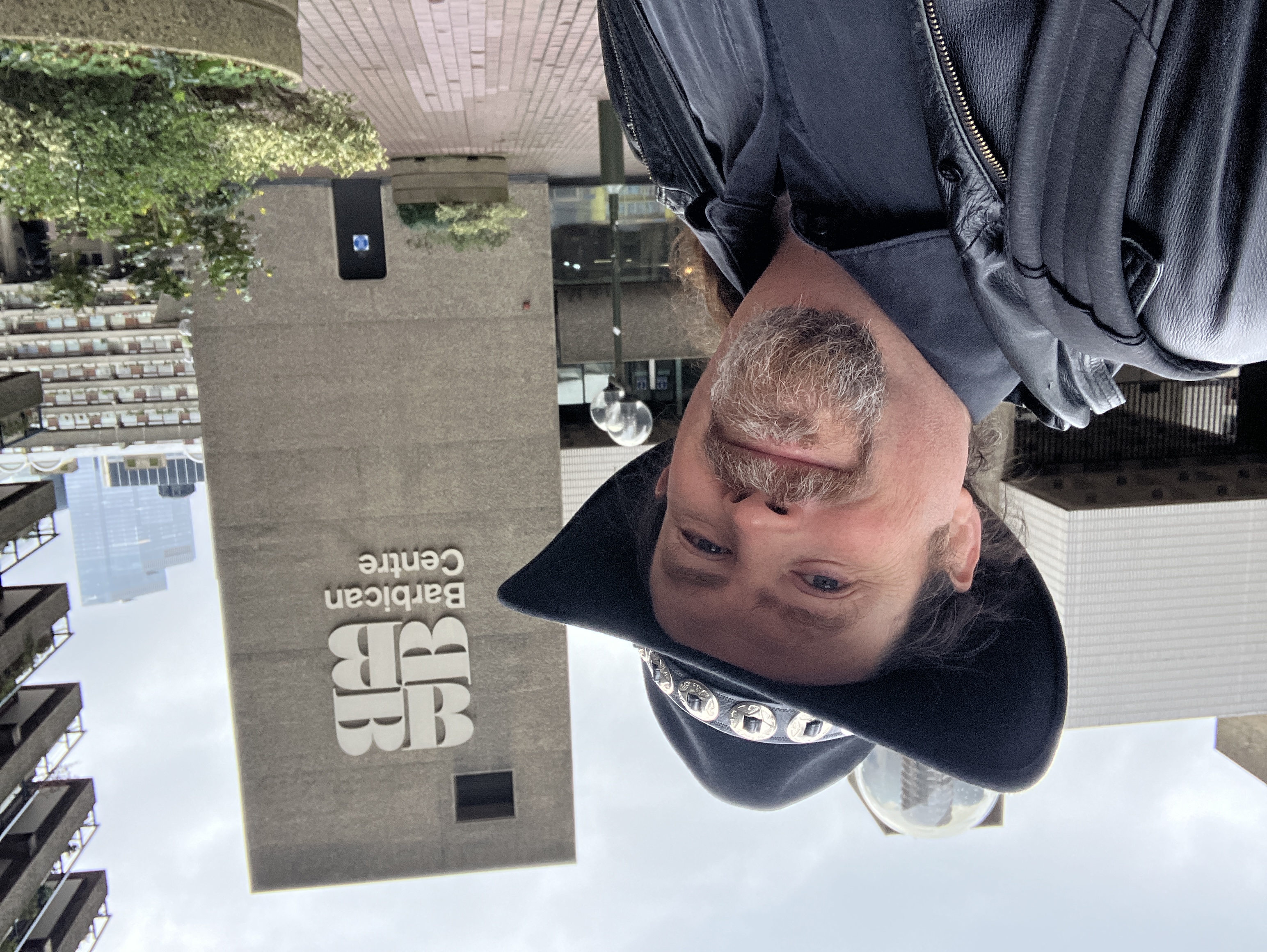
I’ve been here today for State of the Browser (SotB) 2026: a one-day, one-track conference organised by London Web Standards, about browsers. No AI, no crypto, no cloud - just HTML, CSS, JavaScript, and the continuous evolution of the humble web browser. In a dramatic departure from form, I’m not here to speak, or run a workshop, or play a show at the party… I’m here as a regular attendee, to listen and learn and chat to people. I even paid for a ticket. Two, in fact, ‘cos SotB does that thing where you can buy an extra ticket for somebody who wouldn’t otherwise be able to attend, and with my early bird ticket being an extremely reasonable £70 (and the diversity ticket £30), it would have been rude not to.
In a way, the Barbican is the perfect venue for a conference about the state of the web. Like the web, it (mostly!) works; despite its architectural significance, the Barbican isn’t a museum; it’s a living, working event space, theatre, cinema, a library, an art gallery, not to mention home to the thousands of people who actually live here. Like many web standards, it’s controversial: for everybody who loves it and thinks it should be celebrated (hi!) there’s somebody who thinks its an eyesore and we should just tear it all down and start again. And, like those same web standards, maintenance and new development is constantly constrained by the long-term consequences of historic decisions, and the understanding that if you break existing things to add new ones, a lot of people will get very upset.
If you’ve seen me talking about CSS, or email, or HTML, or any number of things over the last few years, you’ll know I love a good standard. Protocols, not platforms; I want to live in a world where what we do online - work, play, consume, communicate - is governed by open standards driven by transparent collaboration, not a series of megacorporation walled gardens. I enjoy events like State of the Browser partly because a lot of the people there share that perspective, but also because, dammit, web conferences are joyful. We know the web is infuriating, and idiosyncratic, and every web developer has a list in their head of everything they’d fix if they had a time machine – but the web is also beautiful and wonderful because it’s so accessible. Not in a WCAG sense, but in the sense that when you make a web browser do something neat, everybody sees it, right away. Everybody gets it. It’s shapes and fonts and colour and movement and live demos that make people laugh out loud because they’re genuinely delightful.
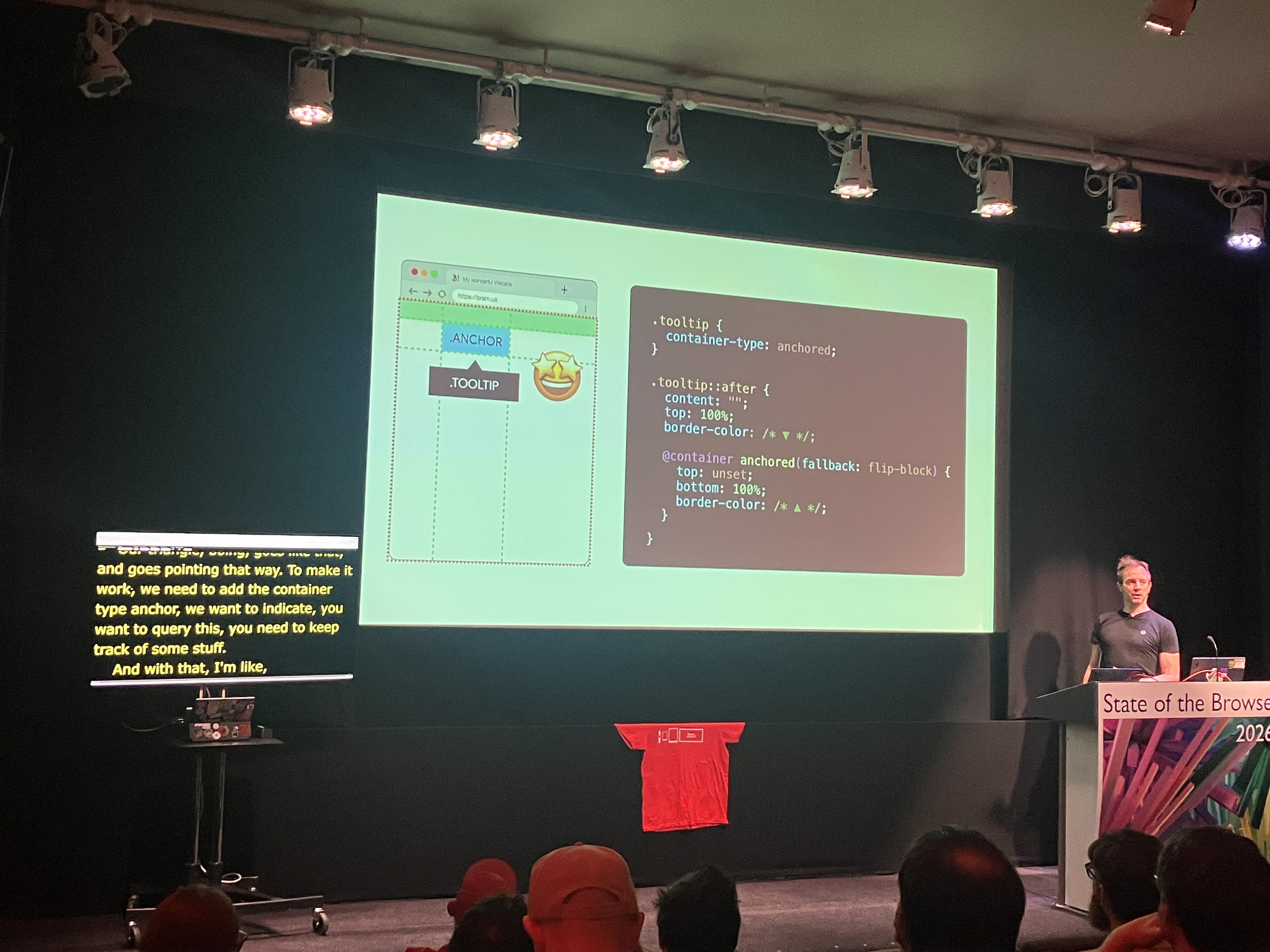
Bramus Van Damme kicked off with a wonderful session about CSS anchor positioning, a relatively new CSS feature that lets you position elements relative to other elements - popups, tooltips, margin notes… you want health bars to appear above the players’ heads in an online game? Or info panels on something like Google Maps? Like a lot of modern CSS features, this doesn’t seem like a big deal until you try to implement it yourself and end up drowning in JavaScript and scrollOffset calculations, and Bramus’s session was a great roundup of the state of the art, the work that’s gone into getting to this point, and what web developers can do with it all.
Fiona Safari’s session about how to thrive at work as an introvert was excellent, but I have to be honest: I don’t think it was the right content for this conference. That’s not any reflection on the presenter - the talk was well researched, well presented, and very relatable in places - but when the event is one day, one track, seven talk slots, and it’s called “State of the Browser”, I expect every session to be about, well, about the state of the browser; about evolving web standards, and what’s changed since last year. Fiona’s session would be a fantastic addition to any number of multi-track conferences, or to an event with a broader scope, but I found the contrast with the rest of today’s sessions to be a little jarring. Fiona: you were awesome; this one’s entirely down to the programme committee.
Chad Gowler’s session on the limitations of WCAG as a model for evaluating accessibility had some brilliant insights - not least the observation that “when something’s terrible for everybody, it’s not an accessibility problem, it’s just a bit shit”, backed up by the example of how a hyperlink that’s styled exactly the same as the surrounding text, and so effectively invisible, is WCAG compliant because it isn’t relying on colour alone for discoverability. Also, turns out many video games do a much better job of making their content accessible and inclusive than most websites (did you know the X-Box packaging, the physical box your games console came in, is designed to be openable by visually impaired folks? Today I Learned.)
Zach Leatherman took us on a delightful riff through the history of the web, framed by asking how you’d build an image comparison component with every iteration of web technology from HTML 1.0 through to modern CSS. There was some truly insightful discussion of the “temporal dead zone” between the component being rendered and actually being usable, and tips on how to work around it – and I have to shout out to the image map example for dusting off some code I’ve not seen in decades and putting it to genuinely hilarious effect.
As an aside: There was also the thing where Zach took a framed photograph out of his bag, placed it on the stage, and somebody from the audience ran up with another framed photograph and placed it alongside it, which felt like it split the room into the people who were laughing out loud ‘cos they knew exactly what was going on, and the people who didn’t get it at all and, maybe, had the slightest sense they’d gatecrashed a private party and weren’t supposed to be here (hi!)… I know as well as anybody that conferences lead to cliques; you see the same people in the same places, year after year, you become friends, you have callbacks and running jokes and it’s all part of the fun, and I’m sure I’ve been guilty of it myself on more than one occasion… but hey, today was a reminder to me that when something like that happens, it only takes a minute to explain to the rest of the room what’s going on, and bring them all in on the joke.
One of the ways SotB keeps ticket prices manageable is they don’t provide lunch, but Barbican’s surrounded by good restaurants; I followed the crowd to a Korean barbecue place for fried chicken and rice, got an excellent cappuccino from Giddy Up, a tiny coffee stand hidden inside Fortune Street Park, and then back for the afternoon sessions.
Jason Williams, the creator of Boa - an experimental JavaScript engine built in Rust - talked us through the story of Temporal, a replacement for JavaScript’s much-maligned Date object; seven years of specification work, prototyping, experimentation, proposals and counterproposals and meetings and working groups - including the not-inconsiderable side quest of getting the IETF to update the RFCs regarding the ISO8601 date format to include time zone name and calendar metadata. It was also great to see Ujwal Sharma’s date on the RFC in question; I met Ujwal a few times, back when we were doing conferences in Russia (yeah, that used to be a thing!) and it’s great to see that he’s gone on to work on some properly excellent stuff.
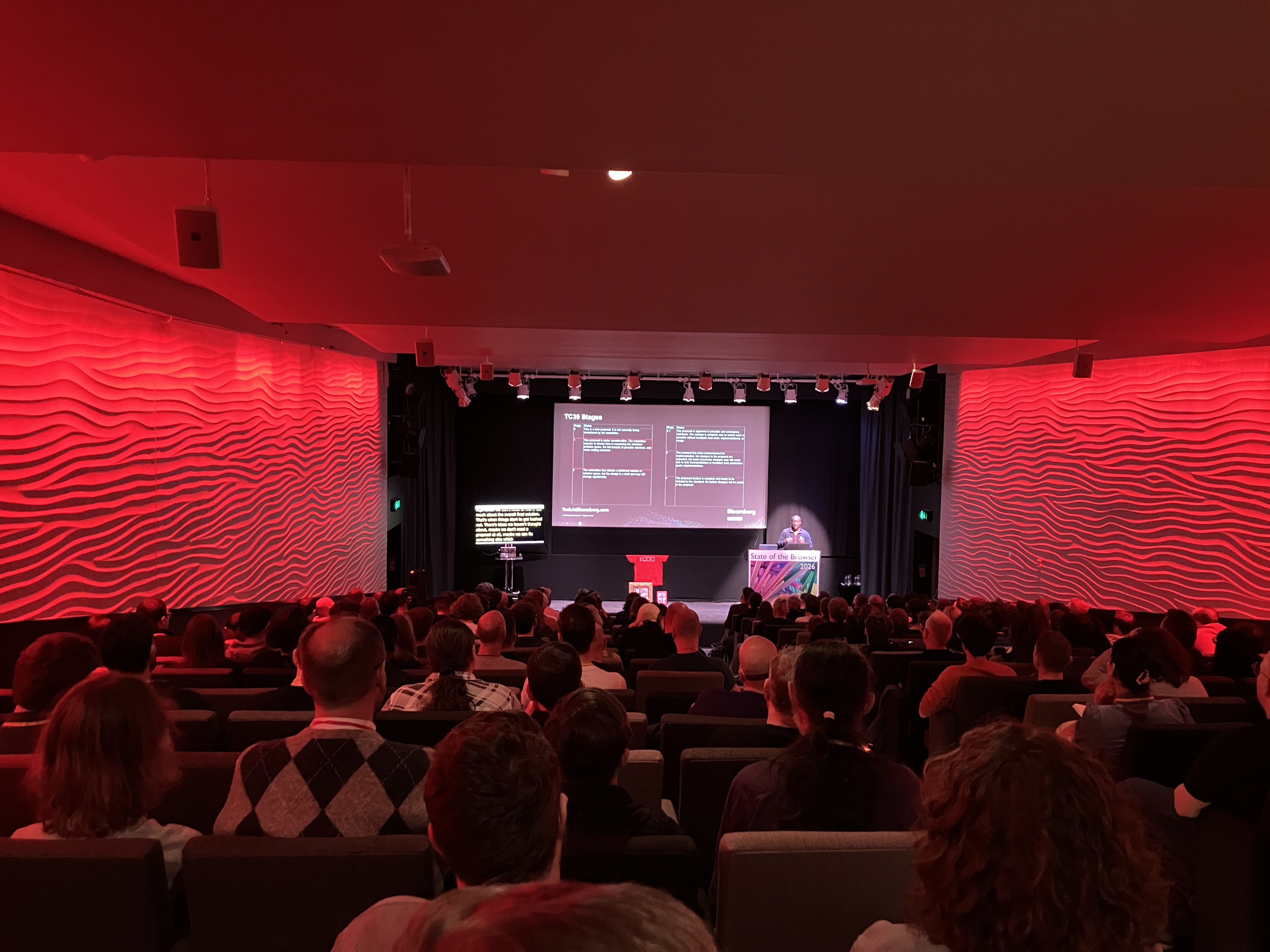
My only real criticism of Jason’s session was this one single slide, and that’s mainly ‘cos it was on the screen for a long, long time while he talked us through the various stages of the TC39 engineering process. I will keep saying this until people listen: MORE SLIDES, FEWER WORDS, BIGGER TEXT. If you want to talk us through six stages of a development process, and each stage has a small paragraph explaining it? That’s six slides. Six nice, big, chunky slides. The rest of it was spot-on; great content, great insight, great examples.
Ever built a website that has to work on Nokia features phones, 320x240 displays with D-pad navigation running Opera Mini, via unreliable 2G and EDGE data networks? Mike Hall has, and his session, “Lessons from Building for the Bottom of the Web”, was a tour de force of engineering within some fairly unique constraints: no web fonts, maximum page sizes, optimised SVGs, building custom minification routines for HTML (including replacing spaces with newlines ‘cos that’s the same number of bytes but if your entire web page is on one line Internet Explorer would crash), and the resulting observation that if you build a web app that’s responsive and usable on a Nokia feature phone, it’ll probably be blistering fast and work on literally everything.
And then Cassie Evans closed out the day in style live-coding (or rather, live-uncommenting) a browser game built around the GSAP animation engine - a lot of code, a lot of laughs, the kind of session that makes you want to go home and open up an editor and play around with all the things in the demo because it just looks like so much fun.
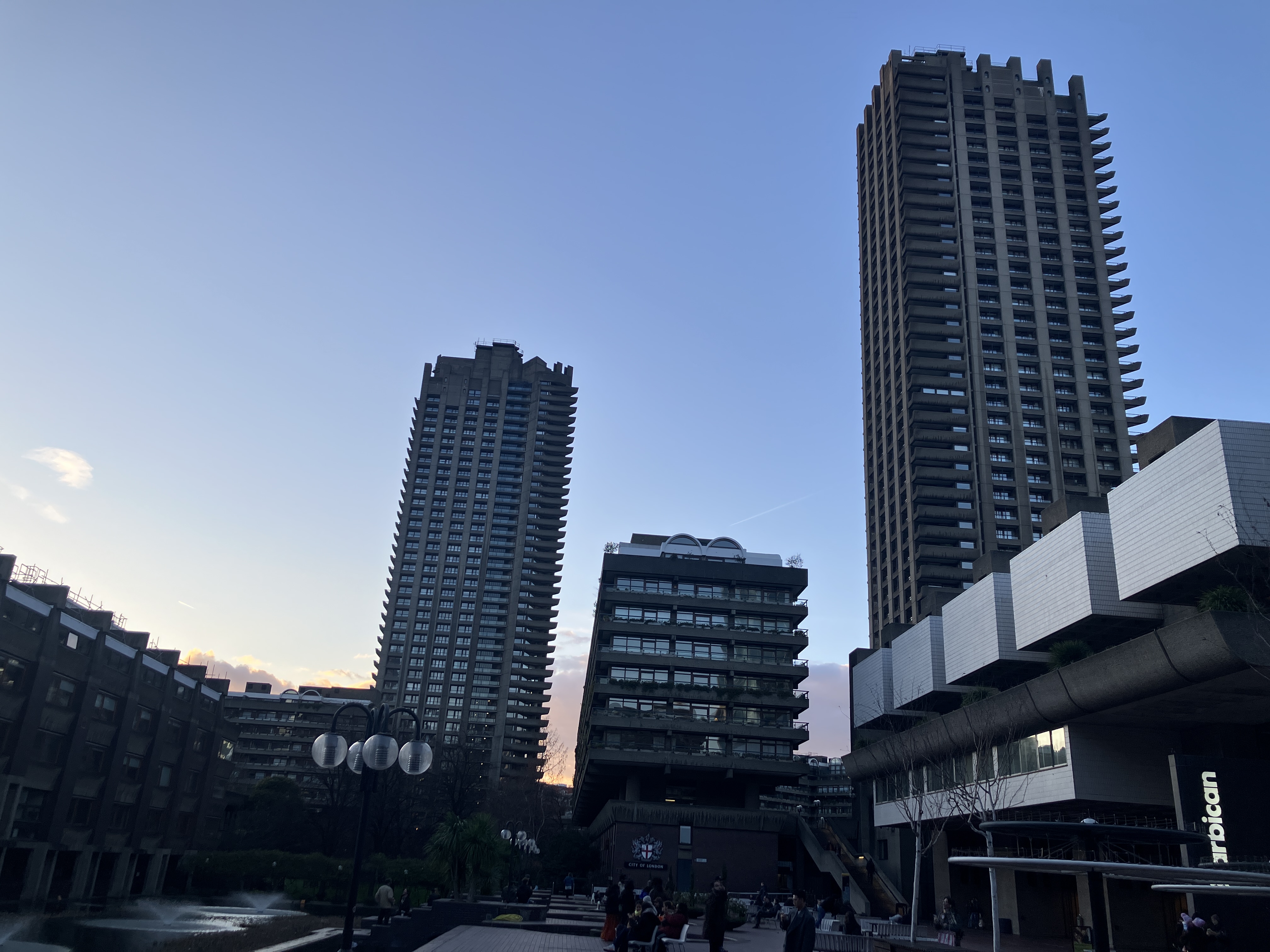
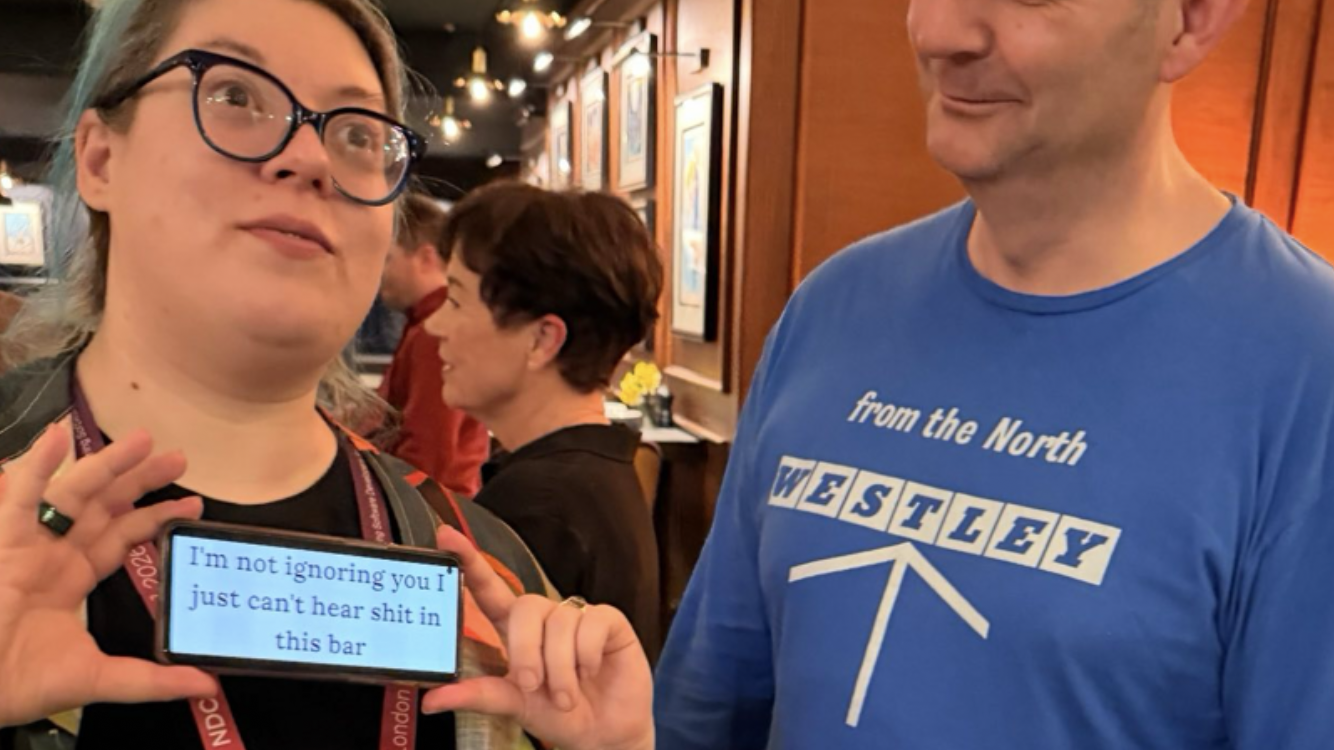
By the time we head out, the sky’s cleared and the setting winter sun is catching the curves and contours of the concrete and it’s all so beautiful the only thing to do is go and reflect on it all over a nice glass of something, and so now I’m writing this in the corner of one of those post-event pubs where the acoustics are so bad everybody’s shouting at everybody else because nobody can hear anybody anyway.
If AI really is going to replace software development with a 24/7 diet of botslop and existential dread, somebody forgot to tell the web folks. State of the Browser 2026 was a celebration of code, craft, open standards, collaboration and transparency, and not a ralph loop in sight.
I’ll leave you with a call to action. At the end of the day, Bruce Lawson - one of the genuinely excellent people who is working tirelessly to keep the web open and transparent and joyful - pointed us to an ongoing UK government inquiry about requiring Apple and Google to provide better interoperability and access to key features of those vendors’ mobile devices and operating systems.
They need your help. If you’re building web apps, or mobile apps, or any kind of software that targets Apple mobile devices, and you’d like to see a more robust transparency mechanism than “Apple promises to be nice if you ask nicely”, get involved. Go here, tell them what you’re working on, tell them why things like forcing Apple to allow browser engines other than Webkit on their iOS devices would be a Good Thing:
And that’s it for now. I’ll see y’all on https://twitch.tv/dylanbeattie on Monday afternoon, where I’ll be beating Claude Code with a length of pipe until it stops lying to me, and then I’ll be in Malmo on Saturday for Beauty in Code 2026, but right now I’m going to go and drink a very loud pint.
I might put Eli’s sign on my phone screen first: